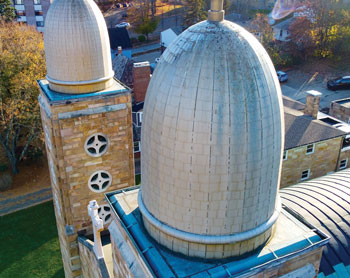
Nick Lardas, president of NIKO, recalls his initial reaction when the church reached out. “Someone gave them my name because we specialize in monumental sheet metal and design,” he says. “When they called me, I happily went out to meet with them.” What the church showed him were two aging, egg-shaped domes in need of total replacement, as well as a picture of the gleaming, golden domes of St. Michael’s Monastery in Kyiv, Ukraine. “They simply said, ‘We want them to look like this,’ ” Lardas recalls.
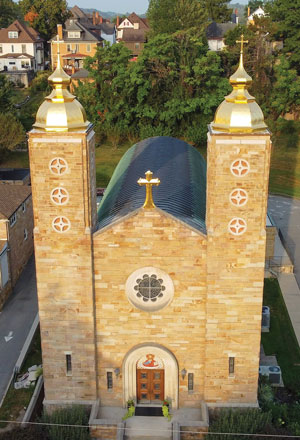
After receiving that single photograph and concise request, the NIKO team burst into action and would go on to build everything—progressing from design drawings to the wood structure, copper cladding, and gold leaf gilding. The result now majestically rises above Carnegie, a testament to home-grown artistry, skill, and community connection.
As noted, the entire project started not with measurements or architectural plans, but with a picture. Lardas, along with NIKO superintendent and designer Philip Kratsas, began by uploading the image into specialized drawing software. “We took the picture and [Phil] began the intricate process of drawing over it with the computer to create the correct shapes,” Lardas describes. When the design was finally perfected and the digital model was in place, fabrication could begin.
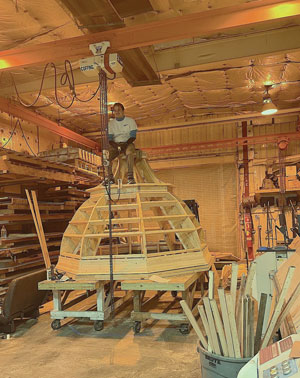
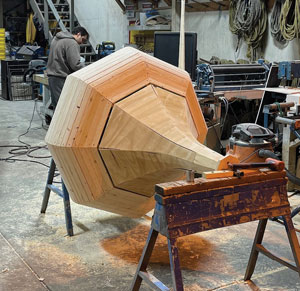
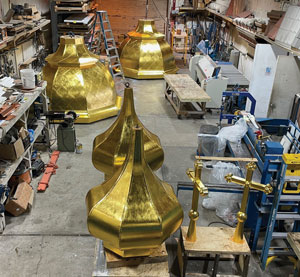
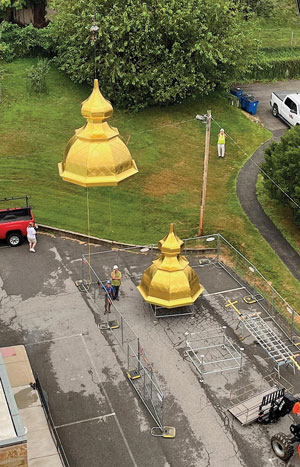
Each dome consists of three major components: the base, middle section, and the ball and cross at the top. Kratsas explains that the underlying portion required careful planning. “The most challenging part was designing the structure,” he says. “You’ve got to figure out how to get that shape, support it, and make sure it can withstand environmental weather conditions like strong winds.” A structural engineer also analyzed their drawings and recommended adjustments, including additional anchoring because the domes had to be meticulously integrated with wood curbing and a final concrete attachment.
NIKO started the design work in January 2025, with the church initially hoping for completion by that Easter. But delays, mostly from the masonry work that needed to be finished beforehand, pushed installation to late summer. Yet, as anyone can clearly see, the final result was well worth the wait.
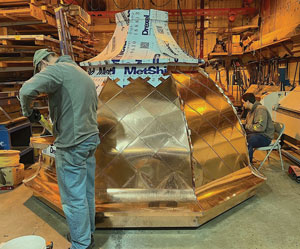
The fabrication itself blended traditional craftsmanship with modern tools. The internal form of each dome was built from wood framing and sheathing. Over this, the construction team installed an ice-and-water shield as a protective underlayment. Then came the copper skin, which was custom shaped. Only after the copper was complete could the impressive gilding process begin.
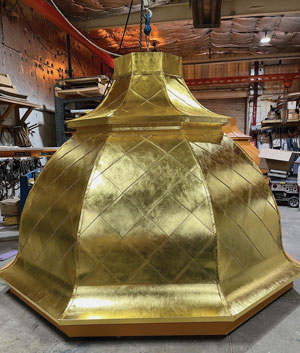
The domes’ luminous finish comes from 23.75- carat gold leaf—real gold, applied by hand in small sections by gilder Joseph Kadri. The process is exacting and time sensitive. “We clean the copper and add three coats of special enamel, which is yellow to orange in color,” Lardas says. “Then we put on something called sizing, which is basically an adhesive with a limited time-window—you wait a minimum of eight hours, but no more than sixteen—and then you apply the gold.”
The gold leaf cannot be applied across an entire dome at once; instead it must be done in controlled sections, ensuring a flawless, continuous surface. That beautiful golden gleam, now visible even from the Parkway, is the result of days of steady, delicate work. The combination of wood structure, copper cladding, and gold leaf—executed with a blend of digital design and artisan skill—results in domes that can last a century or more. “These domes will last as long as that church will last,” Lardas believes.
Although NIKO has completed major dome and roofing projects across the country—including St. Basil’s Church in Houston, as well as others in Texas, New Jersey, and New York—this one definitely stands out. “We’re really proud of it,” Lardas says. “No one else has done one in Pittsburgh recently.” Unlike many past projects, where the structure already existed and the company was replacing or upgrading pre-formed elements, Holy Trinity’s domes required full conception—from initial design through final installation. “This was more of a turn-key project,” Kratsas adds. “We handled everything from beginning to end.”
Starting “from scratch from a photograph,” as Lardas puts it, gave the NIKO team a rare opportunity of translating an artistic vision into a structurally sound, three-dimensional reality. “Compared to some of our other projects, this was definitely more of a challenge,” Kratsas notes. “There was just more designing and visioning involved.”
Kratsas agrees, noting that architectural sheet metal combines both engineering and creativity. “There’s a lot of artwork involved,” he says. “And when you’re done, you have a nice, beautiful product instead of just a basic, functional structure.”
For both men and the rest of the NIKO team, the Holy Trinity Ukrainian Catholic Church domes they created represent not only technical achievement but an artistic and historic contribution. They are part of the Carnegie skyline now, part of the community, and part of Pittsburgh’s architectural story. As Lardas concludes, “Starting from scratch and coming out with a completed project that looks like this—it’s just so gratifying.”
Christopher Cussat is a Pittsburgh-based freelance writer whose words often gleam like 23.75-carat gold. Read more of his work at: cussat.com.