
With the endless rows of houses clinging to the hillsides of Lawrenceville, it is difficult to imagine a time when the area was dominated by fields and forests.
Part of what we know as Lawrenceville was originally a farm called Good Liquor, owned by Alexander Hill. Hill was also the owner and proprietor of an inn near the present 34th Street.
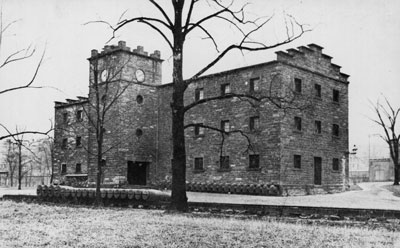
On April 5, 1814, William B. Foster purchased 123 acres from Alexander Hill as a real estate venture at a cost of $35,000. Shortly thereafter, he sold 30 acres to the government for the purposes of an arsenal. Foster retained four acres for his own home, divided the balance into plots for resale, and laid out the town of Lawrenceville.
Foster commissioned the famous architect Benjamin Latrobe to design his extensive frame house, which he nicknamed the White Cottage. In many respects, his estate in the present-day 3600 block of Penn Avenue was at least partially self-sustaining.
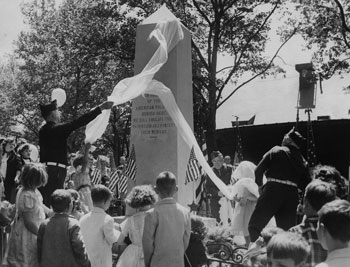
In 1814 William Foster donated one and one-quarter acres of land for the purpose of a burying ground for soldiers stationed at the nearby arsenal. Later, members of the community were permitted to be buried there. A monument on the grounds of the present-day Foster Community Center commemorates Lawrenceville’s first cemetery.
Foster’s real estate venture did not prove to be a wise investment. Although he made a disproportionate profit on the sale of land to the federal government, as early as 1821 the brick inn and stables reverted to Alexander Hill because of Foster’s inability to meet mortgage payments. By 1826 he lost most of his property to the Bank of the United States for non-payment of his mortgage.
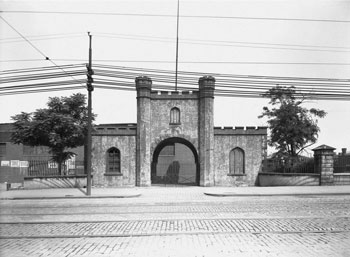
In times of war, employment at the Allegheny Arsenal mushroomed to accommodate increased production of cartridges, leather goods, caissons, limbers, and gun carriages. After the military conflicts were over, employment levels shrank dramatically.
One of the earliest references to the military facility near Pittsburgh involved the court-martial of Lieutenant James Hall following a series of failed attempts to capture an army deserter in December 1816. Hall was dismissed from military service, but was reinstated following his appeal to President James Monroe. Soon afterwards, Hall resigned his commission, took up the practice of law, and settled in Pittsburgh. In 1820 he self-published a 104-page book, Trial and Defence of First Lieutenant James Hall, of the Ordnance Department. This may be the first book to reference the United States Arsenal near Pittsburgh that detailed the events surrounding this incident.
In 1817 the neighborhood joyously celebrated the arrival of President James Monroe at Lawrenceville. The President stopped at the village to inspect the progress on the arsenal.
There is evidence that as early as 1818 an elegant hackney coach was offering service between Pittsburgh and John Mean’s Tavern in Lawrenceville. Apparently, this service only lasted one season. The next record of any form of public transportation did not take place until the 1840s, when Mr. Naser began to run over the same line, using coaches seating 12 passengers that were drawn by two horses. The Pittsburgh-Lawrenceville route was the first in the region to boast a street railway.
The line, which first stretched from Sixth Street to 26th Street, was later extended into Lawrenceville.
In the early days of Lawrenceville, the community had a Masonic lodge. Organized in 1819 as the Hamilton Lodge Number 173, this organization was constituted on February 20, 1820.
The little village was swarming with activity in 1825 when the Marquis de Lafayette visited the hamlet. The French nobleman, like other prestigious visitors, stopped at the arsenal.
By 1826, Lawrenceville was little more than a struggling village of 200 inhabitants; but by 1850, there were 1,600 people living in the community.
The architectural historian James Van Trump noted that Lawrenceville grew up largely between 1860 and 1900. After its annexation by the City of Pittsburgh in 1868, Lawrenceville increased in size, and its population hit 33,000 in 1900.
In addition to heavy industry, Lawrenceville was also home to a number of breweries. After a merger of smaller breweries in 1899 to form the Pittsburgh Brewing Company, the Liberty Avenue facility became the flagship of the new business venture.
Lawrenceville reached its zenith in 1900. It was a thriving community with commercial and retail stores lining both Butler Street and Penn Avenue. Approximately 30 churches, many public and parochial schools, two hospitals, and numerous social and fraternal societies were thriving in Lawrenceville. It could truly be described as a self-contained community. Anything anyone wanted or needed could be found in Lawrenceville.
James Wudarczyk is a researcher for the Lawrenceville Historical Society. He is the author or coauthor of 16 books on local and Civil War history, and of numerous articles; he is a frequent lecturer and tour guide.